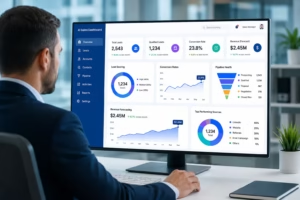

What if your marketing system could tell you which prospects are most likely to become customers before they actually buy?
Instead of sending the same email to everyone, chasing every lead manually, or waiting for customers to show obvious buying intent, imagine having an AI-powered system that continuously analyzes customer behavior and identifies the people most likely to convert.
That is the promise of predictive marketing automation.
Traditional marketing automation follows predefined rules.
For example:
If someone downloads an ebook, send them an email.
Predictive marketing automation goes further.
It analyzes patterns across customer behavior, engagement, CRM data, and other signals to estimate what a customer is likely to do next—and then uses those predictions to trigger the right marketing action.
For businesses trying to generate more qualified leads, improve conversions, and scale marketing without constantly increasing manual work, this can create a significant advantage.
What Is Predictive Marketing Automation?
Predictive marketing automation combines predictive analytics, artificial intelligence, customer data, and automated workflows to anticipate customer behavior and trigger marketing actions automatically.
Think of it as adding a prediction layer to your marketing automation.
Traditional automation asks:
“What happened?”
Predictive automation asks:
“What is likely to happen next?”
For example, traditional automation might recognize that a visitor downloaded a product guide.
A predictive system can look at additional signals:
- How many pages did they visit?
- Did they return to the website?
- Did they view pricing?
- Did they open previous emails?
- How frequently are they engaging?
- What type of content did they consume?
- Does their behavior resemble previous customers?
The system can then estimate the prospect’s likelihood of converting.
This approach is closely related to AI-powered lead scoring, where machine learning models analyze customer and prospect data to prioritize leads based on their likelihood of conversion.
How Predictive Marketing Automation Works
Predictive marketing automation isn’t magic.
It works by combining large amounts of customer data with machine learning, predictive analytics, and automated workflows.
Here’s a simplified process.
1. Collect Customer Data
The first step is collecting meaningful customer signals.
Depending on your business, this could include:
- Website visits
- Page views
- Pricing-page visits
- Form submissions
- Email opens
- Email clicks
- Content downloads
- Previous purchases
- CRM activity
- Appointment bookings
- Chat interactions
- Product interests
- Campaign engagement
A modern AI-powered CRM can bring many of these interactions together to create a more complete view of the customer journey.
SailoAI, for example, combines lead tracking, CRM, contact management, funnels, workflow automation, email follow-ups, WhatsApp capabilities, and other customer-management functions within one platform.
2. Identify Behavioral Signals
Not every action means the same thing.
Someone visiting your homepage once isn’t necessarily ready to buy.
But imagine another visitor who:
- Reads three product pages.
- Visits your pricing page.
- Downloads a guide.
- Returns two days later.
- Opens your follow-up email.
- Clicks the demo link.
Individually, each action may appear insignificant.
Together, they can represent a strong buying-intent pattern.
Predictive systems analyze these combinations instead of relying on a single event.
3. Predict Customer Intent
The system compares current behavior against historical patterns.
Suppose your previous customers frequently performed the following actions before purchasing:
Pricing page → product comparison → email click → demo booking
When a new prospect starts following a similar pattern, the system can identify that similarity.
The result is a prediction such as:
High likelihood of conversion
This doesn’t mean AI knows the future with certainty.
It means the system uses available evidence to estimate what is most likely to happen.
4. Assign Conversion Probability
The next step is prioritization.
Instead of treating 1,000 leads equally, predictive lead scoring can rank them based on signals associated with conversion.
For example:
| Lead | Conversion Potential | Recommended Action |
|---|---|---|
| Lead A | Very High | Immediate sales follow-up |
| Lead B | High | Personalized offer |
| Lead C | Medium | Nurture campaign |
| Lead D | Low | Educational content |
This changes how marketing and sales teams allocate their attention.
Instead of asking:
“Who should we contact?”
They can ask:
“Which prospects have the strongest evidence of buying intent?”
5. Trigger Automated Actions
Prediction becomes much more valuable when it leads to action.
For example:
High intent detected → personalized email → sales notification → AI follow-up → appointment invitation
Or:
Low engagement detected → educational content → retargeting → re-engagement sequence
This is where predictive analytics and marketing automation become a powerful combination.
What Can Predictive Marketing Automation Actually Predict?
Predictive marketing automation can be used to estimate several important customer behaviors.
Who Is Most Likely to Buy?
One of the most valuable applications is identifying high-intent prospects.
AI can evaluate behavioral patterns and prioritize leads that resemble previously converted customers.
Instead of spending equal resources on every lead, sales teams can concentrate on prospects with stronger conversion signals.
When a Customer Is Ready to Convert
Timing matters.
Contacting someone too early can feel intrusive.
Contacting them too late can mean losing the opportunity.
Predictive systems can identify changes in engagement that indicate increasing purchase intent.
For example:
Awareness → Engagement → Consideration → High Intent → Conversion
Marketing automation can then adjust messaging according to the stage.
Which Leads Are Losing Interest?
Prediction isn’t only about identifying buyers.
It can also identify prospects who are becoming less engaged.
A system might detect:
- Fewer website visits
- Declining email engagement
- Abandoned forms
- Reduced product activity
- Longer periods of inactivity
The marketing workflow can respond automatically with a re-engagement campaign.
What Customers Are Likely to Purchase?
Predictive analytics can also help businesses understand product preferences.
For example, an ecommerce company could identify that customers who purchase Product A frequently become interested in Product B.
That insight can trigger an automated recommendation.
Which Marketing Actions Are Most Likely to Work?
Predictive systems can eventually help marketers understand which:
- messages
- offers
- channels
- content
- CTAs
- follow-up timing
are most likely to generate engagement or conversion.
This moves marketing away from static campaigns and toward continuously optimized customer journeys.
Predictive Marketing Automation vs Traditional Marketing Automation
The difference is important.
Traditional marketing automation typically depends on predefined rules.
For example:
IF customer downloads guide
THEN send email.
Predictive marketing automation introduces intelligence into that process.
Instead of simply responding to an action, it evaluates patterns and estimates what the customer is likely to do next.
| Traditional Automation | Predictive Marketing Automation |
| Rule-based | Data-driven |
| Responds to actions | Anticipates actions |
| Static workflows | Adaptive workflows |
| Basic segmentation | Behavioral prediction |
| Manual optimization | AI-assisted optimization |
| “What happened?” | “What happens next?” |
SailoAI similarly positions AI marketing automation around systems that can analyze behavior, predict intent, personalize experiences, and automate workflows rather than simply executing static rules.
Real-World Example: Predicting Your Next Customer
Imagine you run a SaaS company.
Your website generates 2,000 leads every month.
Your sales team cannot manually research every prospect.
Traditional automation might send every new lead the same five-email sequence.
Predictive marketing automation takes a different approach.
Step 1: Track behavior
The system sees that a prospect:
- visited the homepage
- viewed the pricing page
- read two case studies
- returned three times
- opened an email
- clicked a demo link
Step 2: Identify the pattern
The AI compares this behavior with historical customers.
It recognizes that similar behavior frequently occurred shortly before conversion.
Step 3: Increase the lead score
The prospect is moved into a high-intent segment.
Step 4: Trigger an action
The system automatically:
- sends a personalized follow-up
- alerts the sales representative
- recommends a demo
- updates the CRM
- starts a relevant nurture workflow
The sales representative doesn’t have to discover the opportunity manually.
The system surfaces it.
That’s the real power of predictive marketing automation:
Prediction + prioritization + action.
6 Major Benefits of Predictive Marketing Automation
1. Higher-Quality Leads
Instead of focusing purely on lead volume, businesses can prioritize lead quality.
Predictive lead scoring helps identify prospects that demonstrate behaviors associated with conversion.
2. Faster Sales Follow-Up
Timing can dramatically affect the outcome of a sales conversation.
When a prospect shows strong buying signals, automated systems can notify sales teams or trigger immediate follow-up.
3. More Personalized Marketing
Customers don’t all need the same message.
Predictive systems can help businesses adapt content, offers, and follow-up based on individual behavior.
4. Reduced Marketing Waste
If your marketing team spends money targeting people who are unlikely to convert, acquisition costs rise.
Predictive targeting helps allocate resources toward prospects with stronger potential.
5. Better Customer Journeys
Instead of moving every customer through the same funnel, businesses can create adaptive journeys.
One customer might need educational content.
Another might need a product comparison.
A high-intent prospect might need a demo.
Automation can help deliver the appropriate next step.
6. Scalable Growth
The biggest advantage may be scalability.
A human marketer can analyze dozens or hundreds of leads.
An AI-powered system can evaluate much larger datasets continuously.
That allows smaller teams to operate sophisticated marketing workflows without adding the same amount of manual work.
How AI Lead Scoring Fits Into Predictive Marketing Automation
AI lead scoring is one of the most practical applications of predictive marketing automation.
Traditional lead scoring might assign points manually:
- Email opened = +5
- Form submitted = +10
- Pricing page viewed = +15
The problem is that these rules assume every signal has the same meaning.
AI-based lead scoring can analyze combinations of behaviors and historical conversion patterns instead.
For example, the system may discover that a combination of:
multiple pricing visits + high email engagement + company profile + demo interaction
is strongly associated with future conversions.
The model can then prioritize similar prospects.
SailoAI’s AI lead-scoring content describes this approach as analyzing behavioral, engagement, CRM, and other signals to rank prospects according to conversion likelihood.
How SailoAI Helps Turn Predictions Into Automated Actions
Predictive marketing only becomes useful when insights can influence what happens next.
That’s where an integrated AI marketing platform can help.
SailoAI combines an AI-powered CRM with lead tracking, funnels, workflow automation, AI agents, email follow-ups, WhatsApp capabilities, unified inbox functionality, and other tools designed to manage the customer journey.
Instead of stitching together multiple disconnected tools, businesses can build a workflow such as:
Lead captured → behavior analyzed → lead prioritized → AI follow-up → appointment booked → CRM updated → sales action
SailoAI also offers AI funnels and AI agents designed to automate parts of lead generation, engagement, qualification, and conversion.
The goal isn’t to remove marketers or salespeople.
It’s to give them better signals and automate repetitive actions so they can spend more time on strategy, relationships, and closing opportunities.
How to Implement Predictive Marketing Automation
You don’t need to automate everything at once.
Start with a focused use case.
Step 1: Identify Your Conversion Event
Decide what you want to predict.
Examples:
- Purchase
- Demo booking
- Consultation
- Subscription
- Sales-qualified lead
- Repeat purchase
Step 2: Collect Behavioral Data
Bring together useful signals from your:
- Website
- CRM
- Email campaigns
- Forms
- Funnels
- Sales activity
- Customer interactions
Step 3: Define High-Value Signals
Identify behaviors associated with successful customers.
Pricing-page visits, repeat sessions, product interactions, downloads, and demo requests may all provide useful signals depending on your business.
Step 4: Introduce Predictive Scoring
Use AI to identify patterns between customer behavior and conversion outcomes.
Step 5: Connect Predictions to Workflows
This is critical.
Don’t stop at a score.
Create an action.
For example:
High-intent lead → sales notification
Medium-intent lead → nurture sequence
Low-intent lead → educational campaign
Step 6: Measure and Improve
Track:
- Conversion rate
- Lead-to-customer rate
- Sales cycle length
- Cost per acquisition
- Engagement
- Revenue per lead
Then continuously improve the system using new data.
The Future of Predictive Marketing Automation
Marketing automation is moving from reactive to predictive and increasingly toward autonomous systems.
Instead of marketers manually defining every step, AI systems will increasingly help determine:
- Which customer should receive a message
- What message they should receive
- Which channel should be used
- When the message should be sent
- Which offer should be presented
- When sales should intervene
- Which leads deserve priority
This is already visible in the broader evolution of AI marketing automation, AI conversion optimization, and AI lead generation. SailoAI’s current platform positioning brings together AI brains, AI agents, AI funnels, CRM, workflow automation, and conversational tools as parts of a broader growth engine.
The future isn’t simply about automating more tasks.
It’s about making better decisions automatically.
Final Thoughts
The biggest marketing problem isn’t always a lack of leads.
Sometimes, it’s not knowing which lead matters most, when they are ready, and what they need next.
That’s where predictive marketing automation becomes powerful.
By combining customer data, behavioral signals, predictive analytics, AI lead scoring, and automated workflows, businesses can move beyond simply reacting to customer actions.
They can start anticipating them.
The result is a smarter customer journey:
Capture → Understand → Predict → Personalize → Automate → Convert
For businesses looking to build that system, SailoAI brings CRM, lead management, funnels, AI agents, follow-ups, and workflow automation into a unified platform.
The next customer may already be interacting with your business.
The question is:
Can your marketing system recognize them before your competitors do?